what happens to air pressure when it turns colder
7 Crazy Things That Happen Only When It's Really Cold
The cold is so delightful, well, information technology tin be. In fact, plenty of wacky phenomena, from frost quakes and frozen soap bubbles to foursquare tires and soda slushies, are possible, or practical, just when temperatures dip below freezing.
So equally you stay toasty indoors, free of frostbite, check out these 7 "cool" effects of sub-zero temperatures. [Photos: The eight Coldest Places on Earth]
1. Soda slushy anyone?
Alcohol and soda will transform to a slushy almost magically in the extreme cold.
The fob is simple: But take a soda or an alcoholic beverage out in the snow in a sealed bottle and let it cool for a few hours, and then open it upwardly and scout the slush course.
Unremarkably, pure water freezes at 32 degrees Fahrenheit (0 degrees Celsius). But the added ingredients in soda or alcohol lower the freezing point, making the beverage liquid at supercool temperatures. Opening the soda bottle lowers the pressure inside and releases tiny bubbles of carbon dioxide that serve as the seeds for tiny ice crystals, forming a frosty and delicious slush. The technique also works with alcohol or mixed drinks, because opening the canteen is nevertheless usually plenty to seed the tiny ice crystal formation.
Be careful not to make the potable too boozy, though. Pure alcohol freezes at a frigid minus 173 degrees Fahrenheit (minus 114 degrees Celsius), so the stronger the alcohol, the colder it will need to exist outside for the fox to work.
Drinking glass and aluminum tend to work better than plastic bottles, and anecdotal reports suggest that diet sodas, which don't have any sugar content, can sometimes yield less-than-stellar results.
two. Plough h2o into snowfall
Playing around with boiling water in cold, windy weather may not be the smartest manner to spend the solar day. That said, the outcome could exist spectacular if you are very careful and in that location is a large enough of a temperature difference betwixt the air and water, with best results occurring once air temperatures dip to minus 30 F (minus 34 C) or beneath, one expert says.
Here's how boiling water "magically" turns to snow: Cold air is very dumbo, meaning its molecules are scrunched close together, leaving lilliputian room for water vapor molecules. When humid water is thrown into that chilly, dry air, there's no place for those water aerosol to go.
"So the vapor precipitates out by clinging to microscopic particles in the air, such every bit sodium or calcium, and forming crystals," Marking Seeley, a climatologist at the University of Minnesota, told LiveScience's Life'southward Piddling Mysteries in 2011. "This is just what goes into the formation of snowflakes." [Photos of Snowflakes: No Two Akin, of Course]
3. Get out your foursquare tires
Residents of Alaska, Montana and other northern climes know they need a plugged-in cake heater under the hood to keep their automobile warm plenty to get-go on below-nada mornings. But there's some other quirk of driving in super-cold weather: square tires.
In cold weather, the dank air inside machine tires contracts, decreasing air pressure. Mechanics use the dominion of thumb that for every drop of 10 degrees Fahrenheit, tires lose 1 pound per square inch (PSI) of force per unit area. This pressure loss causes tires to flatten slightly, leaving the side sitting on the asphalt looking like a pancake.
Tires typically warm up when the car starts moving, but when the mercury hits about minus 30 F (minus 34 C), that doesn't happen very chop-chop. The issue is a bumpy ride as the motorcar runs on non-quite-circular wheels.
Of course, you lot don't have to live nigh the Arctic Circle to have temperature-related pressure problems. Mechanics recommend everyone double-check tire pressure in the wintertime to make sure tires aren't underinflated due to cold weather.
4. Frost quakes
Frost quakes typically strike later on a cold snap rapidly drops temperatures well below freezing. The quick freeze makes ice in the ground swiftly aggrandize and cleft, producing loud booms. Though frost quakes sometimes shake the basis, their effects are localized, so the tremors are rarely caught on convulsion monitors. A like phenomenon called water ice quakes tin loudly crack the ice in lakes and rivers.
Both frost quakes and ice quakes are known as cryoseisms. A few crysoseisms hitting every winter in Canada. They've also been reported in the Northeast, Midwest and Alaska. [Weirdo Weather: vii Rare Weather Events]
5. Wood frogs freeze solid
Wood frogs — native to northern regions of North America, from North Carolina up to Arctic Canada and Alaska — freeze most completely solid during the coldest months of winter: Every bit cold-blooded animals, their body temperatures can't resist changes in ambience temperatures. But the hoppers have evolved a mechanism to survive their frozen stupor, in which their liver breaks down a compound called glycogen into glucose (sugar), and releases that glucose into their bloodstream. The saccharide behaves as a sort of anti-freeze in the animate being'due south blood, keeping information technology alive equally it hibernates through the coldest months of the year.
The frogs can live this way for weeks at a time, until temperatures rising back upward above freezing. At this bespeak, their hearts start to beat; they gulp for air, jiggle their legs, and hop away in search of a mate.
six. Frozen bubbles
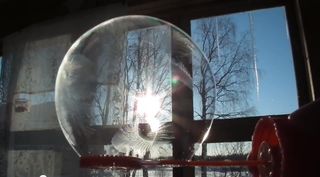
Bubbling can brand any scene seem like a fairy tale, but they pop in the blink of an middle. That'south not an issue when temperatures dip below near 9 to 12 F (virtually minus 11 C), and you can brand the bubbles freeze. The flim-flam is to blow them up in the air and then that they take time to freeze earlier hitting the basis or another surface. The bubbles will form crystalline patterns and some might suspension, looking a chip like the shell of a cracked egg.
7. Tongue freezes to "flagpole"
Skilful thing this one happens only when it'south super-duper common cold. This winter, Maddie Gilmartin, 12, of Eastward Kingston, N.H., tested out the "what happens if you stick your tongue to a frozen metal flagpole." Sure enough, her natural language stuck to the pole, as the New York Daily News notes. Her parents tried to accident warm air on her natural language and douse information technology with warm water to get it unstuck, simply to no avail. Eventually the paramedics freed her, and her tongue, whose swelling could accept upwardly to half-dozen months to go down.
Why does this happen? The tongue is warm, and when it touches the frigid pole, the pole saps that warmth and cools the tongue, causing the body to ship more rut to the cooled area. But the high thermal conductivity of the metal pole means it sucks upwardly that warmth faster than the body can resupply it to the tongue. The issue: The moisture on the tongue freezes in the pores of the tongue and the metallic and, voila, yous're stuck.
LiveScience's Tia Ghose, Becky Oskin, Stephanie Pappas, Laura Poppick, Jeanna Bryner and Andrea Thompson contributed to this article.
Editor'due south Note: This article was updated to include a notation about beingness "very careful" if you lot try the boiling water experiment.
Follow us @livescience , Facebook & Google+ . Original commodity on LiveScience .
Source: https://www.livescience.com/42437-crazy-cold-weather-phenomena.html
0 Response to "what happens to air pressure when it turns colder"
Post a Comment