what did the nixon administration do to help close the economic gap between
President Richard Nixon's actions in 1971 to terminate dollar convertibility to aureate and implement wage/price controls were intended to accost the international dilemma of a looming gold run and the domestic trouble of inflation. The new economical policy marked the starting time of the end of the Bretton Wood international monetary system and temporarily halted aggrandizement.
The international monetary system after Globe War II was dubbed the Bretton Woods organization later on the coming together of forty-four countries in Bretton Forest, New Hampshire, in 1944. The countries agreed to keep their currencies stock-still (but adjustable in exceptional situations) to the dollar, and the dollar was fixed to gilt. Since 1958, when the Bretton Woods system became operational, countries settled their international balances in dollars, and U.S. dollars were convertible to gilt at a fixed exchange rate of $35 an ounce. The United States had the responsibility of keeping the dollar price of gilt fixed and had to arrange the supply of dollars to maintain confidence in futurity gold convertibility.
Initially, the Bretton Woods system operated equally planned. Japan and Europe were still rebuilding their postwar economies and demand for U.S. appurtenances and services—and dollars—was high. Since the United States held almost three-quarters of the globe's official gilded reserves, the organization seemed secure.
In the 1960s, European and Japanese exports became more competitive with U.S. exports. The U.Southward. share of globe output decreased and so did the need for dollars, making converting those dollars to gold more desirable. The deteriorating U.Southward. residuum of payments, combined with armed forces spending and foreign aid, resulted in a big supply of dollars effectually the earth. Meanwhile, the gold supply had increased merely marginally. Eventually, there were more foreign-held dollars than the United States had gold. The state was vulnerable to a run on gilded and there was a loss of confidence in the U.S. government's power to encounter its obligations, thereby threatening both the dollar's position as reserve currency and the overall Bretton Woods system.
Many efforts were made to adjust the U.Due south. balance of payments and to uphold the Bretton Woods arrangement, both domestically and internationally. These were meant to be "quick fixes" until the balance of payments could readjust, simply they proved to be postponing the inevitable.
In March 1961, the U.South. Treasury's Exchange Stabilization Fund (ESF), with the Federal Reserve Banking concern of New York interim every bit its agent, began to intervene in the strange-commutation market for the first time since Globe State of war II. The ESF buys and sells foreign substitution currency to stabilize conditions in the commutation charge per unit market. While the interventions were successful for a fourth dimension, the Treasury'south lack of resource express its ability to mount broad dollar defense.
From 1962 until the closing of the U.Southward. gold window in August 1971, the Federal Reserve relied on "currency swaps" as its key mechanism for temporarily defending the U.S. gold stock. The Federal Reserve structured the reciprocal currency arrangements, or swap lines, by providing foreign key banks cover for unwanted dollar reserves, limiting the conversion of dollars to aureate.
In March 1962, the Federal Reserve established its offset swap line with the Bank of French republic and by the end of that year lines had been ready with ix central banks (Austria, Belgium, England, France, Federal republic of germany, Italy, kingdom of the netherlands, Switzerland, and Canada). Altogether, the lines provided upward to $900 one thousand thousand equivalent in foreign substitution. What started as a small, short-term credit facility grew to be a large, intermediate-term facility until the U.S. gold window closed in Baronial 1971. The growth and need for the swap lines signaled that they were not but a temporary fix, but a sign of a fundamental trouble in the monetary system.
International efforts were too made to stem a run on gilded. A run in the London gold market sent the price to $forty an ounce on October twenty, 1960, exacerbating the threat to the organisation. In response, the London Gold Pool was formed on November 1, 1961. The pool consisted of a group of eight central banks (Cracking Britain, Westward Frg, Switzerland, kingdom of the netherlands, Belgium, Italia, France, and the United States). In club to go on the toll of gilt at $35 an ounce, the group agreed to pool aureate reserves to intervene in the London gold marketplace in order to maintain the Bretton Wood system. The pool was successful for six years until another gilt crisis ensued. The British pound sterling devalued and another run on aureate occurred, and France withdrew from the puddle. The pool collapsed in March 1968.
At that time the seven remaining members of the London Gilded Puddle (U.k., West Germany, Switzerland, kingdom of the netherlands, Belgium, Italy, and the United States) agreed to formulate a two-tiered system. The central banks agreed to apply their aureate but in settling international debts and to not sell budgetary aureate on the private market. The two-tier system was in place until the U.S. gold window closed in 1971.
These efforts of the global financial community proved to be temporary fixes to a broader structural problem with the Bretton Woods system. The structural problem, which has been chosen the "Triffin dilemma," occurs when a country issues a global reserve currency (in this case, the United States) because of its global importance as a medium of exchange. The stability of that currency, however, comes into question when the country is persistently running current account deficits to fulfill that supply. As the current business relationship deficits accumulate, the reserve currency becomes less desirable and its position as a reserve currency is threatened.
While the U.s. was in the midst of the Triffin dilemma, it was too facing a growing trouble of aggrandizement at habitation. The flow that became known as the Great Aggrandizement had started and policymakers had put anti-inflation policies in place, only they were short lived and ineffective. At offset, both the Nixon administration and the Federal Reserve believed in a gradual approach, slowly lowering aggrandizement with a minimum increase in unemployment. They would tolerate an unemployment rate of up to iv.5 percent, but past the finish of the 1969-70 recession the unemployment charge per unit had climbed to half dozen percent, and inflation, equally measured past the consumer toll index, was five.4 percent.
When Arthur Burns became chairman of the Board of Governors in 1970, he was faced with both tedious growth and inflation, or stagflation. Burns believed that tightening monetary policy and the increase in unemployment that accompanied it would exist ineffective against the inflation then occurring, because it stemmed from forces beyond the control of the Fed, such equally labor unions, nutrient and energy shortages, and OPEC's control of oil prices. Moreover, many economists in the administration and at the Fed, including Burns, shared the view that inflation could not be reduced with an acceptable unemployment rate. According to economist Allan Meltzer, Andrew Brimmer, a Fed Board member from 1966 to 1974, noted at that time that employment was the main goal and fighting inflation was the 2d priority. The Federal Open up Market Committee implemented an expansionary monetary policy.
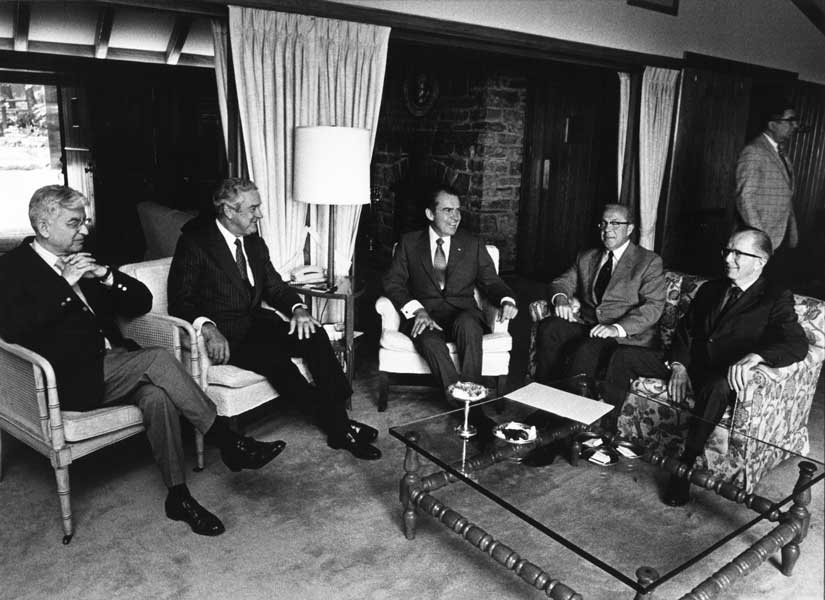
With inflation on the rise and a gold run looming, Nixon's administration coordinated a program for assuming activeness. From August thirteen to fifteen, 1971, Nixon and fifteen advisers, including Federal Reserve Chairman Arthur Burns, Treasury Secretary John Connally, and Undersecretary for International Budgetary Affairs Paul Volcker (subsequently Federal Reserve Chairman) met at the presidential retreat at Military camp David and created a new economic programme. On the evening of August 15, 1971, Nixon addressed the nation on a new economical policy that not simply was intended to correct the balance of payments but as well stave off inflation and lower the unemployment rate.
The first order was for the golden window to be closed. Strange governments could no longer exchange their dollars for gold; in effect, the international monetary system turned into a fiat one. A few months later the Smithsonian agreement attempted to maintain pegged exchange rates, merely the Bretton Woods organization concluded soon thereafter. The second order was for a 90-day freeze on wages and prices to bank check inflation. This marked the first time the government enacted wage and price controls outside of wartime. It was an attempt to bring down inflation without increasing the unemployment rate or slowing the economy. In improver, an import surcharge was set at x percent to ensure that American products would not be at a disadvantage because of exchange rates.
Soon after the plan was implemented, the growth of employment and product in the United States increased. Aggrandizement was practically halted during the 90-day wage-price freeze only would before long reappear as the monetary momentum in support of aggrandizement had already begun. Nixon's new economic policy represented a coordinated attack on the simultaneous problems of unemployment, inflation, and disequilibrium in the remainder of payments. The plan was one of the many prescriptions written to cure aggrandizement, which would eventually go on to rise.
Bibliography
Bordo, Michael. "The Bretton Woods International Monetary Organization: A Historical Overview." In A Retrospective on the Bretton Woods System: Lessons for International Budgetary Reform, edited past Michael Bordo and Barry Eichengreen, 3-108. Chicago: University of Chicago Press, 1993.
Bordo, Michael D. and Barry Eichengreen, "Bretton Woods and the Great Aggrandizement," NBER Working Newspaper 14532, National Bureau of Economic Enquiry, Cambridge, MA, Dec 2008.
Bordo, Michael, Owen Humpage, and Anna J. Schwartz, "Bretton Woods, Bandy Lines, and the Federal Reserve'due south Return to Intervention," Working Paper 12-32, Federal Reserve Bank of Cleveland, Cleveland, OH, November 2012.
Burns, Arthur, "The Ache of Central Banking," The 1979 Per Jacobsson Lecture, Belgrade, Yugoslavia, September thirty, 1979.
Eichengreen, Barry. Exorbitant Privilege: The Rise and Fall of the Dollar and the Future of the International Monetary Arrangement. New York: Oxford University Printing, 2011.
Eichengreen, Barry, "Global Imbalances and the Lessons of Bretton Wood," NBER Working Newspaper 10497, National Bureau of Economic Research, Cambridge, MA, May 2004.
Eichengreen, Barry. "Epilogue: Three Perspectives on the Bretton Woods System." In A Retrospective on the Bretton Wood Organisation: Lessons for International Monetary Reform, edited past Michael Bordo and Barry Eichengreen, 621-58, Chicago: Academy of Chicago Press, 1993.
Federal Reserve Depository financial institution of New York.Annual Study: 1971, via FRASER.
Federal Reserve Bank of New York. "Substitution Stabilization Fund." May 2007.
Lowenstein, Roger, "The Nixon Shock," Bloomberg Businessweek, August 4, 2011.
Meltzer, Allan H., "U.Due south. Policy in the Bretton Woods Era," Federal Reserve Banking company of St. Louis Review 73, no. 3 (May/June 1991): 53–83.
Meltzer, Allan H., "Origins of the Corking Inflation," Federal Reserve Bank of St. Louis Review 87, no. 2, office 2 (March/April 2005): 145–75.
Meltzer, Lloyd, Robert Triffin, and Gottfried Haberler. International Budgetary Policies.Postwar Economic Studies No. 7. Board of Governors of the Federal Reserve Arrangement, September 1947, via FRASER.
Romer, Christina, "Commentary on Meltzer's Origins of the Great Inflation," Federal Reserve Depository financial institution of St. Louis Review 87, no. 2, part 2, (March/April 2005): 177-85.
U.S. Department of Country Office of the Historian. "The Bretton Forest Conference 1944." Accessed on October 22, 2013.
U.Southward. Role of Emergency Preparedness.Stemming Inflation: The Office of Emergency Preparedness and the 90-24-hour interval Freeze. U.S. Government Press Function, 1972, via FRASER.
Yergin, Daniel, and Joseph Stanislaw. The Commanding Heights. New York: Simon & Schuster, 1998.
Source: https://www.federalreservehistory.org/essays/gold-convertibility-ends
0 Response to "what did the nixon administration do to help close the economic gap between"
Post a Comment